
Cycle of Improvement: Implement the Plan
Plans only lead to change when they are implemented effectively. In this phase, teams put their strategies into action with clarity, consistency, and the necessary support to ensure they are carried out as intended.
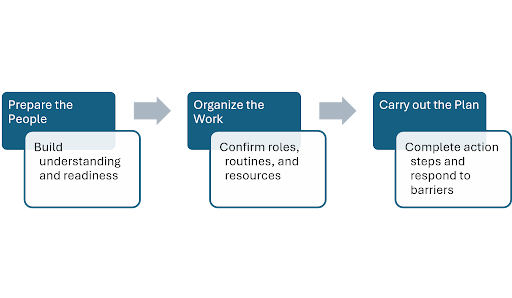
Prepare the People
- Build understanding and readiness
Organize the Work
- Confirm roles, routines, and resources
Carry out the Plan
- Complete action steps and respond to barriers
Before implementation begins, ensure that the people responsible for the work understand the selected strategy, why it was chosen, and what it should look like in practice. Teams should identify the knowledge, skills, resources, and ongoing support staff will need to implement it successfully.
Questions to consider
- Do staff understand the need and root cause the strategy is intended to address?
- Do they understand how the strategy connects to the priority and goals?
- What are the strategy’s essential components?
- What should implementation look and sound like in practice?
- What professional learning, modeling, coaching, or practice is needed?
- What resources and conditions must be in place before the work begins?
- Which parts of the strategy can be adapted locally, and which must remain consistent?
Familiarity is not Readiness.
Introducing a strategy or providing materials does not ensure that staff are prepared to implement it. Readiness requires shared understanding, opportunities to learn and practice, access to resources, and ongoing support.
Activate the implementation team
Return to the team structures established earlier in the Cycle of Improvement. For each priority or evidence-based strategy, confirm the implementation team responsible for coordinating the work, supporting staff, addressing barriers, and keeping the School Improvement Team informed.
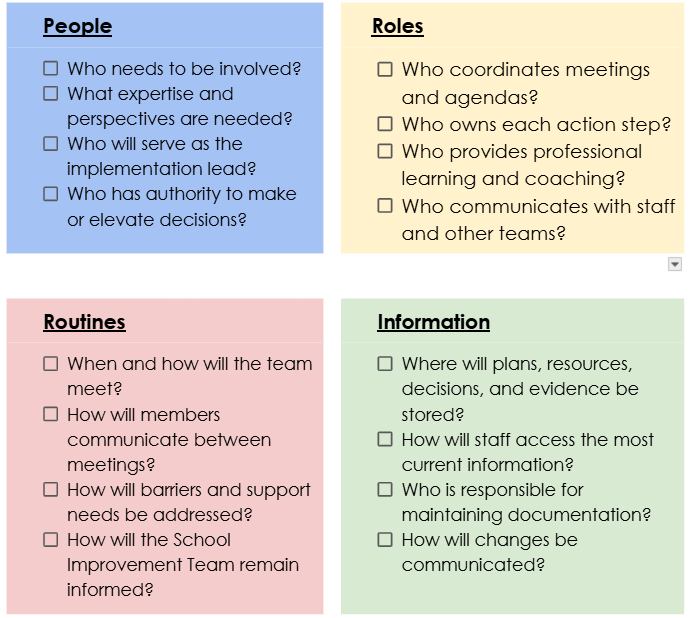
Shared responsibility still requires clear ownership.
Many people may contribute to an action step, but one person should be accountable for coordinating the work and ensuring it moves forward.
The action plan serves as the roadmap for implementation. Implementation teams coordinate the people, resources, communication, and support required to complete each action step within the identified timeframe.
As the work begins, teams should maintain a shared understanding of what is happening now, what comes next, who is responsible, and where additional support is needed.
As the strategy is implemented, teams will begin gathering the evidence identified in the plan. The next phase, Monitor the Plan, explains how that evidence is used to examine implementation quality, progress, and impact.
Before launching the work, confirm:
- The implementation team and lead are identified
- Staff understand the strategy and its purpose
- Essential components of the strategy are clearly defined
- Roles and action-step ownership are assigned
- Meeting and communication routines are established
- Necessary time, resources, and professional learning are available
- Documentation has a shared and accessible location
- Staff know where to go when they encounter a barrier or need support