
Cycle of Improvement: Set the Direction
Strong improvement work begins with clarity and alignment. In this phase, teams establish the structures, organize the right people, and create a shared vision for learning that will guide their efforts.
The sections below will help you put the foundation in place so your work is focused, coordinated, and centered on what matters most for students.

Who will lead, plan and carry out the work?

What shared commitments will guide the work?
Establish Teams
Establishing a committee inclusive of a diverse group of stakeholders is critical to the success of the school improvement plan process. The Every Student Succeeds Act (ESSA) requires that this committee include the principal/chief school administrator and other school leaders, teachers, students (if a secondary school), parents/guardians and members of the community.
Effective school improvement requires clear team structures. Each team serves a different purpose, while maintaining communication and alignment across the work.
Individuals may serve on more than one team. The goal is not necessarily to create three entirely separateLibrary groups, but to ensure that the advisory, planning, and implementation responsibilities are clearly assigned.
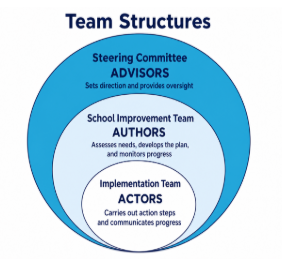
Staying Connected
- The Implementation Team communicates progress, barriers, and emerging needs to the School Improvement Team.
- The School Improvement Team uses that information to monitor the plan, make adjustments, and keep the Steering Committee informed.
- The Steering Committee provides direction, feedback, and support to maintain alignment with the school’s broader vision.
Role: Advises
Primary purpose
Sets the direction, establishes the vision for the improvement plan, and provides guidance and oversight throughout the process.
Key responsibilities
- Establish the vision and direction
- Ensure alignment with broader district priorities
- Represent and consider multiple stakeholder perspectives
- Stay informed about progress and major decisions
- Provide feedback and guidance to the School Improvement Team
Possible members
Chief school administrator, building principal, district and school leaders, educators, students, families, community members, and the School Improvement Facilitator.
Role: Authors
Primary purpose
Leads the improvement process by assessing needs, developing the plan, and monitoring both implementation and impact.
Key responsibilities
- Conduct the comprehensive needs assessment
- Identify priorities and root causes
- Develop the school improvement plan
- Monitor implementation monthly
- Examine impact quarterly
- Recommend adjustments when needed
- Keep the Steering Committee informed
Possible members
Building principal, school leaders, educators, staff connected to the identified priorities, and the School Improvement Facilitator.
Role: Acts
Primary purpose
Carries out and monitors the specific actions included in the improvement plan.
Key responsibilities
- Complete assigned action steps
- Review action-level evidence biweekly
- Identify barriers to implementation
- Adjust action steps when appropriate
- Communicate progress and concerns to the School Improvement Team
Possible members
Educators, instructional coaches, behavior specialists, interventionists, and other staff directly responsible for the work.
Establish Direction
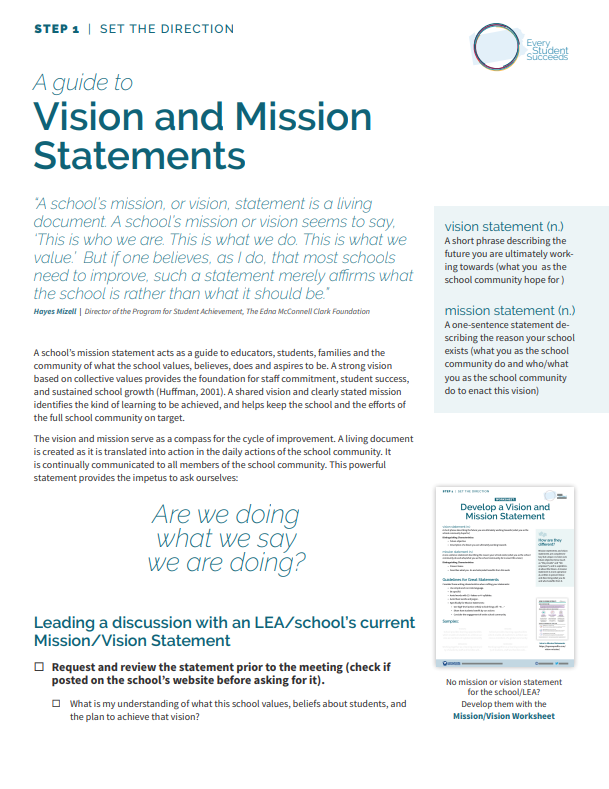
Establishing an agreed-upon vision for the school is the first step in plan development. The vision should embody the school community’s best thinking about teaching and learning. A school needs to know where it wants to be in order to improve. The vision provides stakeholders with a common direction for growth, something that inspires them to continuously strive to better meet students’ needs. LEAs and/or schools may already have a vision statement that has been approved with the Comprehensive Plan. If so, build upon this established vision with a specific focus on a vision for student groups targeted for continuous improvement.
Steps to Complete a Vision Statement for Learning
- Facilitate a discussion about your school’s vision for students with the continuous improvement team.
- Determine whether the school’s vision reflects current beliefs about teaching and learning and needs of students in the community you serve.
- If necessary, revise the vision statement to reflect the committee’s feedback.
- Finalize your agreed upon vision statement.
Guiding Questions for Schools
- What is the school’s vision for teaching and learning?
- What will students know and be able to demonstrate upon graduation from your school?
- What values and beliefs are reflected in the vision statement?
- Does the vision statement align with the needs of the community we serve?
- How will we know if we achieved our vision?