Cycle of Improvement: Introduction
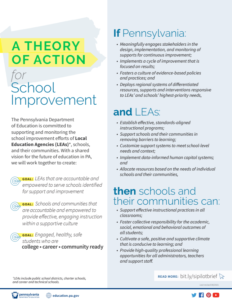
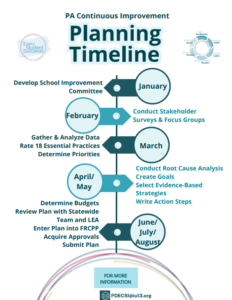
Before jumping into planning and implementation, it’s important to understand how school improvement is designed and supported. This section provides key context, including school designation, how improvement efforts are structured, the theory of action that guides decision-making, and the timeline that organizes the work across the year.
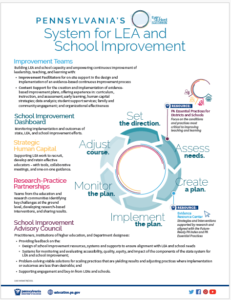
Begin with the Pennsylvania’s System for LEA and School Improvement to build a shared understanding of the process and how each phase of the cycle fits together.
ESSA Requirements for School Improvement Designations
ESSA requires states to develop a plan to designate schools for support and improvement. In a significant change from the No Child Left Behind era, these designations derive from both academic and non-academic student success indicators, and include both school-wide and student group-level determinations. ESSA requires states to specify a standard for the number of students, or minimum “n-size,” that trigger the reporting of academic and other data at the school and student group levels. Pennsylvania’s n-size is 20.
Accountability Indicators in PA
- Indicators required by the Every Student Succeeds Act (ESSA):
- Achievement – Percent Proficient
- Academic Progress – Growth • Graduation Rate – Four- and Five- year cohort rates
- English Learner Proficiency
- Additional Indicators selected by PA
- Career Standards
- Regular Attendance
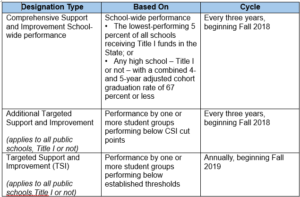
Specifically, the process of designating schools for support – termed “Annual Meaningful Differentiation” by the federal statute – results in three distinct designations: 1) Comprehensive Support and Improvement (CSI); 2) Additional Targeted Support and Improvement (A-TSI); and 3) Targeted Support and Improvement (TSI) detailed on the table below:
PA’s System for LEA and School Improvement
Supports based on Designation
Your support system is assigned based on your designation.
School Improvement Facilitators (SIF) work out of local IU’s and support Pennsylvania’s designated schools. They:
- Empower schools and their communities to lead their own improvement through a cycle of improvement;
- Engage school teams in a facilitated self-assessment of essential practices associated with improved teaching and learning, prioritizing strengths and needs, and conducting a root-cause analysis;
- Support the school as this information is used to develop, implement, and monitor an improvement plan; and
- Cultivate a culture of evidence where proven strategies are identified, assessed for appropriateness, implemented with fidelity, and evaluated for impact.
In addition to their SIF, LEA’s with CSI designated schools will be assigned a Regional Lead to provide district level support and have access to resources and support provided by the Performance Management Team.
Learn more about the Performance Management team on their website: https://www.berksiu.org/page/performance-management
Or connect with members of our support team using our Contact Page
Additional Resources