
Cycle of Improvement: Assess Needs

What Strengths and challenges exist within our system?

What factors are producing or sustaining the challenge?
Part 1: Conduct a Needs Assessment
A needs assessment is a systematic process for identifying strengths and challenges within a school’s context. It brings together data, stakeholder perspectives, and evidence about current practices to determine where improvement efforts should be focused.
A needs assessment is a collaborative process not a document completed by one person.
Authentic assessment takes time and includes the people closest to the work, including those who experience the system differently.
PA Essential Practices
The PA Essential Practices for Schools and Communities provide a common framework for examining the systems and practices that support student success. Teams use the 18 Essential Practices to identify areas of strength, examine gaps between current and desired practice, and select practices for deeper investigation.
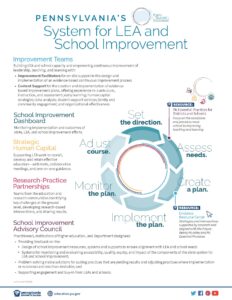
When conducting a Needs Assessment, ratings are the beginning of the conversation, not the conclusion.
When team members assign different ratings, examine the evidence and explore why their experiences of the practice may differ.
By the end of the needs assessment, your team should have:
- A shared understanding of current strengths and challenges
- Evidence supporting its Essential Practices ratings
- Identified differences in stakeholder experiences
- One or more prioritized Essential Practices for deeper analysis
- A clearly defined student-level challenge connected to the prioritized practice
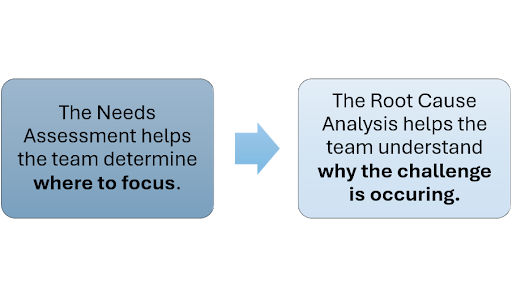
1. Gather evidence
Review multiple forms of evidence connected to student outcomes, implementation, school practices, and stakeholder experiences.
2. Assess current practice
Use the Essential Practices rubric to determine the school’s current level of implementation. Ratings should be supported by evidence rather than perception alone.
3. Prioritize for deeper analysis
Identify the practices that are both strongly connected to the school’s student-level challenges and important enough to warrant focused improvement.
A comprehensive needs assessment brings together multiple forms of evidence to develop a fuller understanding of the school’s strengths and challenges. Teams should consider not only student outcomes, but also how consistently practices are being implemented, how stakeholders experience the system, and the conditions that may influence results.
No single data source tells the whole story. Look across the four evidence areas below to identify patterns, differences, and questions that warrant deeper investigation.
- Student Outcomes: Achievement, growth, attendance, engagement, behavior, graduation
- Implementation Evidence: Whether existing programs, routines, and practices are being carried out consistently
- Perception Evidence: Experience of students, families, educators, and other members of the school community
- Context and Systems: Staffing, schedules, access, resources, policies, leadership, and organizational conditions.
Part 2: Root Cause Analysis
A root cause is an underlying factor that contributes to an identified problem and that, if addressed, would meaningfully improve the outcome. Root cause analysis is the process of investigating the interconnected factors that produce or sustain the problem.
Most complex school challenges do not have one root cause.
They emerge from interacting practices, conditions, decisions, beliefs, and experiences. The goal is to identify the most influential and actionable contributing factors, not to discover one perfect answer.
By the end of root cause analysis, your team should have:
- A clearly defined, evidence-based problem
- A broad set of possible contributing factors
- Evidence used to test key assumptions
- A small number of influential and actionable contributing causes
- A clear connection among student outcomes, prioritized Essential Practices, and contributing causes
Before investigating causes, define the challenge in specific, evidence-based language. A useful problem statement identifies:
- Who is affected
- What is happening
- Where or when it occurs
- The evidence demonstrating the gap
- How the result differs from what is expected
Do not begin root cause analysis with a solution already in mind.
“Teachers need professional development” is a proposed response, not a description of the problem or evidence of its cause.
The protocols below offer different ways to explore the factors contributing to an identified problem. Consider what your team already understands, where its thinking may be getting stuck, and the level of structure it needs when selecting a protocol.
Protocols and when to use them:
- 20 Hunches When the team needs to generate a broad range of possible explanations, surface assumptions, and hear multiple perspectives
- 5 Whys When the team needs to investigate one factor more deeply by repeatedly asking what is contributing to it
- Fishbone When the team needs to organize multiple contributing factors into categories and examine how parts of the system interact
Teams may use more than one protocol. For example, 20 Hunches can generate possibilities, a Fishbone can organize them, and 5 Whys can help investigate a particularly influential factor.
Explore
- What conditions, practices, or decisions may be contributing to this result?
- Where and when is the problem most and least visible?
- Which students or staff experience the system differently?
- When better outcomes occur, what is different?
Test
- What evidence supports this explanation?
- What evidence challenges it?
- Are we identifying a cause, describing another symptom, or proposing a solution?
- Are we relying on assumptions about students, families, or staff?
Prioritize
- Which factors have the strongest connection to the identified problem?
- Which factors can the school or LEA influence?
- If this factor changed, is there reason to believe the student outcome would improve?
- Does the factor connect to the prioritized Essential Practice?
Root causes should describe systems, conditions, and practices, not assign blame.
Statements such as “families do not value attendance” or “students lack motivation” close off investigation. Ask what school-controlled conditions may be shaping participation, access, trust, expectations, or engagement.
20 Hunches
Fishbone Diagram
5 Whys